Why Do Garage Floors Peel in Florida? (And How to Prevent It)


There are few things more frustrating than paying for a fresh garage floor, loving it for a season or two, and then watching it start to bubble, flake, and peel up in sheets — often right where you back the car out. If it's happened to you, you're not alone, and if you're trying to avoid it, you're asking exactly the right question before you spend a dollar.
Here's the honest truth: in Florida, peeling garage floors are almost never bad luck. They're the predictable result of a few specific mistakes — and every one of them is preventable. Let's walk through why it happens here in particular, and what a floor has to have to survive.
Florida is uniquely brutal on garage floors
Most floor-coating advice online is written for the whole country. But a garage floor in Southwest Florida faces a combination of conditions that would be unusual almost anywhere else:
High moisture and a high water table under slab-on-grade homes
Intense heat that softens weak coatings
Relentless UV and sun exposure
Constant humidity during installation and curing
Each of these can wreck a floor on its own. Together, they punish any coating that wasn't specifically built — and installed — for this environment. Here are the real culprits behind peeling.
Cause #1: Moisture coming up through the slab (the big one)
This is the number-one reason Florida floors fail, and the one most installers ignore.
Florida homes are built on concrete slabs poured directly on the ground — ground that often has a high water table. Moisture continuously wicks up through the concrete as vapor. When an installer seals the top of that slab with a coating, the vapor has nowhere to go. Pressure builds underneath, and it literally pushes the coating off the concrete from below. The result is blistering, bubbling, and peeling — usually a few months after a floor that looked perfect on day one.
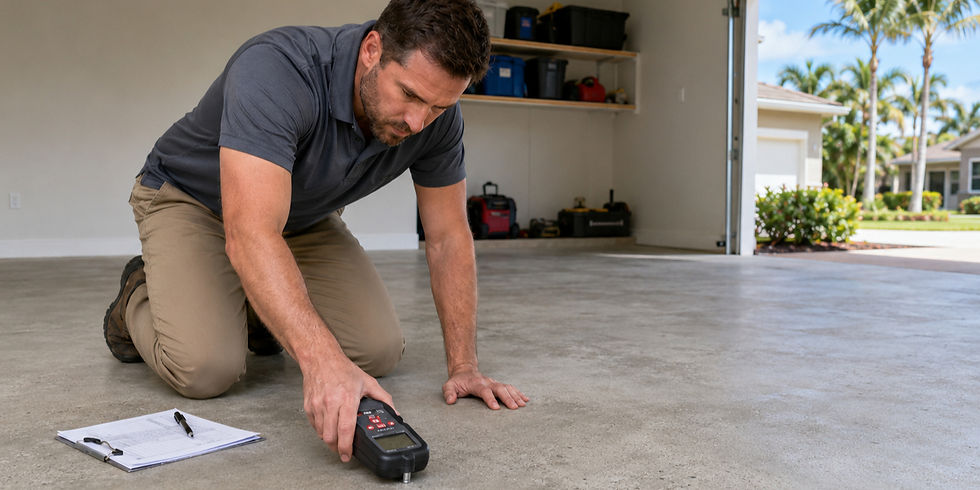
How to prevent it: the slab must be tested for moisture before anything is applied, and if levels are high, a moisture-mitigation layer goes down first to hold that vapor back. This single step separates floors that last from floors that fail — and it's the step budget installers skip to save time.
Cause #2: Bad surface preparation
A coating doesn't just sit on concrete like paint — it has to bond to it. For that bond to form, the slick top layer of the concrete has to be mechanically opened up.
The right way is diamond grinding, which profiles the surface so the coating grips it. The shortcut is acid etching — a chemical wash that's cheaper and faster but leaves an inconsistent, unreliable surface. Floors prepped by acid etching (or barely prepped at all) simply don't have enough grip to stay down, and they peel. If a past quote you got involved washing the floor with acid instead of grinding it, that's a red flag.
Cause #3: The wrong coating for Florida sun and heat
Not all coatings are built to survive here.
Ordinary epoxy yellows, chalks, and gets brittle under UV — our sun is merciless on coatings that aren't UV-stable.
Cheap coatings soften in the heat, which leads directly to the next problem.
A floor built for Florida uses a UV- and chemical-resistant polyaspartic topcoat over a solid base — a system designed to take the sun and heat without breaking down.
Cause #4: Hot-tire pickup
This one has a specific name because it's so common. Your tires heat up while you drive. You pull into the garage, park on a weak or under-cured coating, and as the hot rubber sits there it softens the coating and grabs it. When you back out, the coating lifts right off with the tire.
Hot-tire pickup is a Florida-heat problem made worse by inferior products and floors that weren't given proper cure time. A correctly specified, fully cured system doesn't do it. (We wrote a whole post on hot-tire pickup if you want the deeper explanation.)
The common thread: shortcuts
Notice the pattern. Every cause above traces back to a corner cut to hit a lower price — skipping the moisture test, acid-etching instead of grinding, using a cheaper coating, rushing the cure. A floor that peels wasn't unlucky. It was under-built.
That's also why the cheapest quote so often becomes the most expensive floor: once a coating peels, someone has to grind off the failed material before it can be redone — harder and costlier than starting on bare concrete. You end up paying for the floor twice. (We break the numbers down in our garage floor coating cost guide.)
How to make sure your floor never peels
If you want a floor that stays down for the long haul, insist on all of these:
Moisture testing and mitigation for your specific slab
Diamond-grind surface preparation — never acid etching alone
A 100%-solids base with a UV-stable polyaspartic topcoat
Full cure time before you park on it
A company that stands behind the work with a real warranty against peeling
The Seagate approach
We started as builders, and we watched too many coating jobs fail on our own projects for exactly the reasons above. So we built our system to prevent every one of them: we test every slab for moisture, diamond-grind every floor, install a four-layer Florida-engineered system with a UV-stable topcoat, and back it with a two-layer warranty that covers peeling and significant fading.
Every free on-site assessment includes a moisture test on your slab — so you know, before any work begins, exactly what your floor needs to last. We serve Port Charlotte, Punta Gorda, North Port, Venice, Englewood, and the surrounding area.
Worried about a floor that lasts? Get your free, no-pressure estimate →


Comments