Epoxy vs. Polyaspartic: What's Actually Best for a Florida Garage?


If you've started researching garage floor coatings, you've run into two words over and over: epoxy and polyaspartic. Most companies push whichever one they happen to install, which makes it hard to get a straight comparison. So let's do that here — what each one actually is, where each is strong, and what the best floors in Florida actually use.
Here's the short version, and it surprises people: the best system isn't epoxy or polyaspartic. It's both, in the right layers. Here's why.
What epoxy is
Epoxy is a two-part resin that cures into a hard, thick, durable layer with an excellent bond to properly prepared concrete. It's the workhorse of floor coatings, and quality matters enormously:
100%-solids epoxy is the premium grade — it cures to a thick, strong film with nothing thinned out of it. This is what a real system is built on.
Water-based or low-solids "epoxy" is the thin, cheap stuff sold in big-box kits — closer to a floor paint, and the source of most DIY disappointment.
Epoxy's strength: as a base coat, 100%-solids epoxy is outstanding — it builds thickness, bonds hard to the slab, and carries the decorative flake beautifully.
Epoxy's weakness in Florida: on its own, as a final exposed layer, epoxy struggles here. Under our intense UV it tends to yellow and get chalky over time, and it's less flexible and less resistant to hot tires than what our climate demands. Epoxy is a fantastic foundation — but it's not the ideal thing to leave on top.
What polyaspartic is
Polyaspartic is a newer coating (a specialized member of the polyurea family) that cures fast and is built for exactly the conditions epoxy struggles with. As a topcoat, it's genuinely impressive:
UV-stable — it won't yellow or chalk in the Florida sun
No hot-tire pickup — hot tires won't soften and lift it
Highly chemical- and stain-resistant — shrugs off gasoline, diesel, oil, and household chemicals
Slip-resistant but easy to sweep — a subtle texture that's safe underfoot yet simple to clean
Fast-curing — a big reason a whole floor can be finished in a single day
Polyaspartic's catch: it's more expensive and it cures fast, which means it demands real skill to apply correctly. In the hands of an inexperienced crew, that speed works against them. This is a product that rewards experience.
So which one wins? Neither — the best floors use both
Here's what the top installers actually do, and what Thomas's crews build on every job: a 100%-solids epoxy base coat for thickness and bond, the decorative flake broadcast into it, and a polyaspartic topcoat to seal it all with UV stability, chemical resistance, and no hot-tire pickup.
You get the best of both: epoxy's strength and build where it belongs (the foundation), and polyaspartic's durability and Florida-proof performance where it belongs (the surface you see, touch, and park on). Anyone selling you only cheap epoxy is leaving your floor exposed to the exact things that fail here; the system approach solves it.
Quick comparison
Epoxy (100%-solids) | Polyaspartic | |
Best role | Base coat / foundation | Topcoat / protective layer |
UV stability | Can yellow & chalk over time | Excellent — won't yellow |
Hot-tire pickup | More vulnerable | Resists it |
Chemical resistance | Good | Excellent |
Cure speed | Slower | Fast (enables 1-day installs) |
Ease of application | More forgiving | Requires skill & experience |
The verdict | Great foundation | Great finish |
Don't forget what's underneath
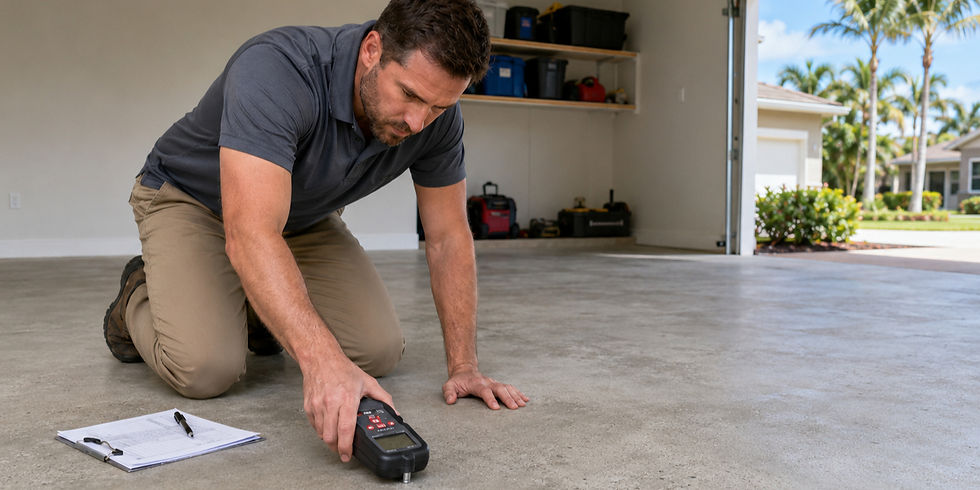
One honest caution: the epoxy-vs-polyaspartic question gets all the attention, but neither one matters if the prep and moisture control are wrong. Even the best polyaspartic topcoat will fail if it's laid over an unprepared, untested slab. The system on top is only as good as the diamond-grind preparation and moisture testing beneath it. (We cover why that matters in our posts on why floors peel and concrete moisture testing.)
The Seagate system
We build every floor as a complete, Florida-engineered system: diamond-grind prep, a moisture test on your slab, a 100%-solids epoxy base, full decorative flake broadcast, and a UV- and chemical-resistant polyaspartic topcoat with no hot-tire pickup — backed by a two-layer warranty against peeling and significant fading.
If you want a floor that looks incredible on day one and still looks that way after years of Florida sun and hot tires, that combination is how you get it. We serve Port Charlotte, Punta Gorda, North Port, Venice, Englewood, and the surrounding area.
Not sure what your floor needs? Get your free, no-pressure estimate →


Comments