What Is a Concrete Moisture Test — and Why Your Floor Fails Without One

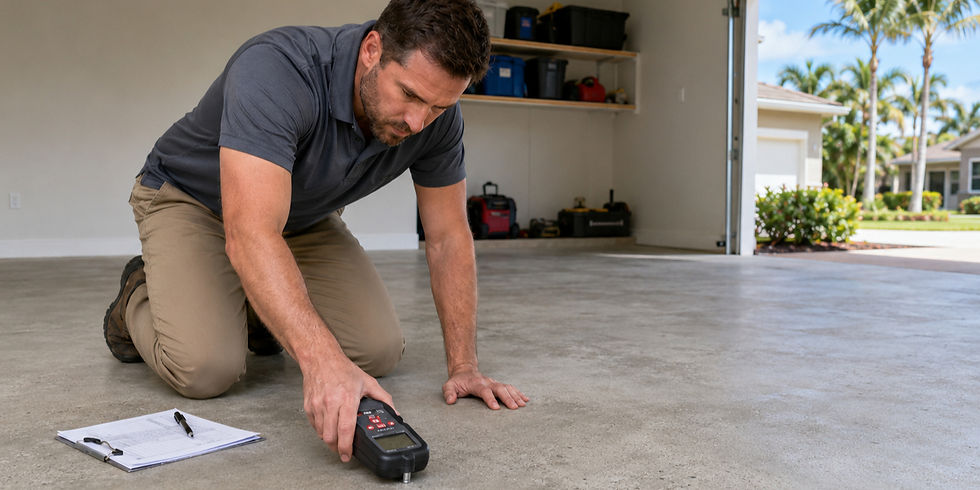
If you've read anything about garage floor coatings in Florida, you've probably seen the word "moisture" come up again and again — usually as the reason floors fail. But almost no one explains what a moisture test actually is, why it matters so much here, or what happens when a company skips it.
It's worth understanding, because this one step is the difference between a floor that lasts fifteen years and one that starts blistering in six months. And in our experience, it's the step cut most often to land a lower price.
Why moisture is the enemy of a coated floor
Florida homes are built on concrete slabs poured directly on the ground — often ground with a high water table. Concrete is porous, so moisture from the earth below is constantly wicking upward through the slab as water vapor. You can't see it, but it never stops.
While the concrete is bare, that vapor simply evaporates into the air. But the moment you seal the top of the slab with a coating, you trap it. The vapor pressure builds underneath the coating with nowhere to go — until it forces the coating off the concrete from below. That's what causes the blisters, bubbles, and peeling that show up months after a floor looked flawless on day one.
Here's the cruel part: the failure isn't the installer's visible work. The floor can be beautifully applied and still fail, because the problem came from underneath — from moisture no one measured.
What a concrete moisture test actually is
A moisture test measures how much water vapor is moving through your specific slab, so the right system can be specced for it. There are a few industry-standard methods, and reputable installers use them:
Calcium chloride test (ASTM F1869): a small dish of moisture-absorbing salt is sealed to the slab for 60–72 hours. Weighing it before and after reveals how much vapor came through — measured as pounds of moisture per 1,000 square feet over 24 hours.
Relative humidity probe test (ASTM F2170): probes are placed into the slab to read the internal humidity deep inside the concrete — often the most accurate method.
Plastic sheet test (ASTM D4263): a quick field check where a plastic square is taped down overnight; condensation underneath signals moisture is present. Useful as a fast screen, but not precise enough to rely on alone.
The point isn't the acronyms — it's that a real number gets measured before anyone opens a bucket of product, instead of hoping for the best.
What happens when the slab tests too high
Finding moisture isn't a dead end — it's information. If a slab reads above safe levels, the fix is a moisture-mitigation system: a specialized layer applied first that's engineered to hold back that vapor pressure, so the decorative coating on top stays bonded.
The problem is that mitigation takes extra product, extra time, and knowledge of how to do it. So the budget move is to skip the test entirely, coat right over the slab, collect the check, and be long gone by the time it bubbles up. That's not a materials problem — it's a shortcut.
Why so many installers skip it (and why the manufacturer won't save you)
This connects to something worth knowing about warranties. Many companies hand you a manufacturer's warranty on the coating product and call it protection. But those warranties are typically voided by improper installation — and skipping moisture testing and mitigation is exactly the kind of installation error that gives the manufacturer an easy reason to deny a claim.
So you can end up with a peeling floor, a manufacturer who won't cover it because it wasn't installed to spec, and an installer who's moved on. The "warranty" turns out to be worth very little precisely when you need it.
This is why proper moisture handling and a workmanship warranty from the installer themselves matter so much more than a product warranty alone.
Moisture testing is part of a bigger standard
A moisture test doesn't stand alone — it's one piece of doing the whole job to spec. It sits alongside:
Proper surface preparation — diamond-grinding the slab to remove the smooth power-troweled surface and expose the porous concrete underneath, so the coating can form a true mechanical bond (rather than the inferior acid-etch shortcut some installers use to save on equipment and time).
The right products — a 100%-solids base and a UV-stable topcoat built for Florida.
The right equipment — the professional-grade grinders and tools that proper prep actually requires.
Skip any one of them and the floor's lifespan drops. Moisture testing is simply the step that's easiest to hide having skipped — until the floor tells on the installer.
How Seagate handles moisture
We started as builders, and moisture-related floor failures were one of the biggest reasons we couldn't find a coating contractor we'd put our name behind — so we made testing non-negotiable. Every free on-site assessment we do includes a moisture test on your slab. If your concrete needs mitigation, we spec it in before any decorative work begins, and we back the finished floor with a two-layer warranty — our own workmanship warranty plus the manufacturer's — against peeling and significant fading.
That means before any work starts, you know exactly what your slab needs to last. We serve Port Charlotte, Punta Gorda, North Port, Venice, Englewood, and the surrounding area.
Want to know what your slab is really doing? Get your free, no-pressure estimate — moisture test included →


Comments